


- Home |
- Links |
- Exhibitions |
- Directions |
- Contact |
- Press |
- Images

 Exhibition Schedule
Recent Press Articles & ReviewsFatherhood Awakens Artist Gibbs Rounsavall
By Erin Keane | WFPL | April, 10, 2013
The strong geometric designs of Gibbs Rounsavall's paintings have made his work among the most recognizable of Louisville's younger guard of visual artists. His work has been widely shown locally, in Zephyr Gallery, Actors Theatre of Louisville and Swanson Reed Gallery, among others, as well as afar, in group shows at Morehead State University and Brooklyn's Museum of Contemporary African Diaspora Art. But his work took a new direction and a new sense of urgency when he and his wife Sara welcomed their daughter Edie to the family in 2011.
"After 36 years, I felt pretty acquainted with who I was, my purpose, and the established routines we had as individuals and as a couple," says Rounsavall. "A baby throws all that out the window."
Now, Rounsavall says his new identity as "Dada" -- the pater familias, not the art movement -- has changed the way he sees the world around him.
"Edie is like a visitor from another planet, where everything is so foreign to her that she treats it all with the same amount of attention, whether it's a brightly-colored toy or a simple cardboard box," he says. " I began to see the world differently through new eyes, almost as if for the first time."
"I was no longer just an artist, or a teacher, or a husband, but a 'Dada' -- and this role carried the most gravitas," he adds. Rounsavall's marvel at Edie's process of discovery and her urgency ("Even crossing a room is done in a full sprint, like her pants are on fire.") sounds familiar to anyone who's spent time with small children. But this experience has shaped his art as well, grounding him in the present, fine-tuning his focus and resulting in his most prolific creative period yet.
Rounsavall began working on a new series shortly after his daughter was born, a series of circular frames, ranging in diameter from 12 to 96 inches in diameter. He's moved his attention away from sharp angles to a softer, more organic fluidity of line. His new work goes on display this week in a solo exhibit, "Awaken," at The Green Building Gallery.
"I am very conscious of making these fine edges, which require total attention and presence of mind. When viewed up close, you can see the line waver and that it is clearly man-made. I love this idea of trying to make this perfect edge, but it never really being quite perfect, always retaining this man-made quality," he says.
The work in "Awaken" is arranged chronologically, with an increasing complexity that mirrors, in a way, his daughter's growing awareness of the world around her that comes through experimentation and experience.
"The first couple of pieces utilize color that radiates from a central point on the surface. Gradually, they become more complex in their structure as the space is broken, divided, twisted, stretched, spun and woven," says Rounsavall. "Many of the pieces progress to include a spiral framework. I have always been fascinated at how prevalent a design structure the spiral is in nature. From the arrangement of sunflower seeds to the spiral galaxy, it’s all around us."
"Awaken" opens Friday at The Green Building Gallery (732 E. Market St.) with a reception at 5 p.m. Review: Real, Realer, Realist exhibitionMarch 21st, 2013 | Published in March 2013 Review of Real, Realer, Realist exhibition: Rick Bennett
From the Renaissance through the neoclassical period, figure painting based on close observation and skilled execution was the most prestigious form of artistic expression. Though this status was considerably diminished during the Romantic, Modern, and Post-Modern periods, it is clear today that realistic figure painting has made a quiet but definite comeback. The exhibition Real, Realer, Realist, curated by Daniel Pfalzgraf, provides an excellent opportunity to see contemporary realist paintings from established national artists and rising stars. The show at the Green Building, 752 East Market St. in Louisville, KY, runs from
February 22-April 10 2013. Pfalzgraf is director of the Green Building Gallery which is located on the ground floor. The Green Building in Louisville opened in the fall of 2008 in the East Market District, the heart of NuLu, Louisville’s arts district and it is the first commercial building in Louisville to go for LEED platinum certification (the US Green Building Council’s designation of a sustainable building). Intent upon rescuing the building from decades of misuse, the project included resuscitating the structural masonry shell and infusing it with a modern core, including a 40 foot high lobby, expansive natural lighting, eco-friendly materials, and renewable energy systems, as well as extensive solar power, geothermal wells, and recycled denim insulation.
There are fifteen paintings in the show and the works have been astutely paired so that they complement each other but each work also has enough space to be contemplated individually. In these paintings meaning is embodied in the marks and colors and has been arrived at though an extended dialog between eye, mind, and hand: you won’t find didactic proclamations or overt political commentary, but the show does deliver psychological depth complex pleasure.
The most striking painting in the gallery is Chloe by Kelly Phelps (54X48” oil on linen) in which the life-size figure is dressed in black, seated in front of a dark tree, and the dark tones contrast sharply with brightly colored fall leaves. The painting makes a big impact from a distance but doesn’t disappoint on closer viewing: in contrast to the loosely painted background and rough tree bark the skin tones of the face have been subtly modulated and carefully blended. There are fallen leaves and a black dress, but the unusual pose and lifelike rendering of the face and hands offsets suggestions of death: The figure seems to grow along with the tree and the painting achieves a thematic balance of old age and youth, death and renewal. In this light the title of the painting connects to the Greek khló?, an epithet for Demeter, the Greek goddess of fertility, grain, and agriculture, who is also responsible for creating winter and the changing seasons.
Adjacent to Chloe is the most psychologically complex work in the show, Self Portrait as Widow (36X24” pastel on Wallis museum grade) by Gaela Erwin. The sitter here is also clothed in black but in this work the formal symmetry of the natural background serves to intensify the distance between art and reality, nature and perception. In the painting we see denial, anger, grief, but not acceptance. Erwin’s intense stare goes through the viewer and seems fixed on a metaphorical mirror as the painting fuses artistic discovery and psychological self-exploration. Erwin’s masterful interplay between line and edge—heightened by the pastel medium—serves to embody the tensions within the work: in some cases the lines are left unaltered and we glimpse the creative process in its most intimate manifestation. These calligraphic lines, like the ones that define seams on the long black gloves, also carry an abstract, self-referential beauty. In other sections of the painting we see skillfully executed edges that leave little trace of the artist’s hand. In subject matter and execution Erwin’s painting intensifies the inherent dualities of the self-portrait genre: artist/model, public/private, actor/role, archetype/individual are all in play, and the more you look at the painting the more mysterious it becomes.
In the atrium, just outside of the gallery, hang several works by Salvador J. Villagran Jr., including the life-size figure painting Waiting (60X48” oil on linen). There is much to see here and along with the skillful draftsmanship and detailed rendering there is a rich interplay between warm and cool colors, particularly the complex greens and flesh tones. The figure reflected in the mirror adds symbolic potential to the sense of anticipation as one window illuminates the figure and the other window is a portal to a mysterious outer world. In classic vanitas fashion Villagran has included a skull behind the sitter and her arm forms a visual bridge between flesh and bone as our eyes are directed from the skull toward the woman’s youthful face.
A more powerful memento mori however is Villagran’s humble portrait entitled Jim (18X14” oil on panel). Villagran’s depiction of the subject’s brawny, tan body suggests a life of achievement and continued virility. The eyes on the other hand provide a sensitive suggestion of middle-age doubt. The question seems to be not “what happens when I die?” but “Have I lived the right life up to now?”
In contrast Steven Assael’s The Swimmer (36X20” oil on canvas) effuses confidence both in the depiction of the model and in the rough but sure-handed application of paint. Assael’s skin tones bring to mind You +1′d this publicly. UndoWillem de Kooning’s statement that “flesh was the reason oil paint was invented.” The translucent quality that Assael achieves helps establish the model’s age, and the interplay between the loosely descriptive passages on the figure’s abdomen and the abstract jabs of paint in the background is powerful. This celebration of imperfection, age, and rugged textures brings to mind the Japanese wabi sabi aesthetic. The thick and painterly surface also acts as a kind of palimpsest, revealing layers of time and process that are consonant with the overall psychological impact of the painting: though he has been through a lot, the swimmer seems to look forward to the next cold splash of experience.
Assael’s other work Cassandra Twice (27X17”oil on board)features the same painterly style but with more dramatic lighting and chiaroscuro. The foreground Cassandra seems outwardly focused and even confrontational, while in the second rendering she seems self-absorbed. By painting two versions of the same model in the same painting Assael adds depth to the portrayal of the model and also to questions implicit in the practice of figure painting from live models. When an established artist paints a nude figure today one wonders how (or if) the political dimensions of class and gender have changed within this relationship since the Renaissance. An interesting aspect of contemporary realism is that although many paintings address “identity politics,” the objectivity that the process demands makes it impossible to know the identity of the artist based on the art itself. Given an overview of contemporary figure paintings you would be quite wrong to assume that most works that resemble those of the “old masters” were painted by white men.
In a work fraught with political possibilities, Kelly Phelps’ Transition (self portrait) (9X12” oil on panel)could be compared to works by Alyssa Monks, Lee Price, Nathalie Vogel, and Cynthia Westwood in the surprisingly large and active subgenre of young women who paint themselves or other young women bathing. As is the case with works by these other painters, Phelps’ painting invites but also defies a generalized interpretation. Unlike a traditional self-portrait pose Phelps’ eyes are averted and the viewer is given a position above the figure. The erotic charge of the image however is both enhanced and undermined by a sense of extreme vulnerability as conveyed through the rendering of wet and porous skin. Phelps doesn’t rely on depiction of water drops or waves, but through subtle blending of warm and cool tones she brings to life a varied landscape of submerged and partially dry flesh. Submersion in water is a nearly universal and timeless vehicle for physical and spiritual transformation, and in this case we seem to be voyeuristically viewing the transition midway through the process.
Phelps describes her paintings as “introspective moments that keep the viewer guessing” and that description fits all of the paintings in this exhibition. We can look for clues and project our interpretations on these works, but this kind of art has more to offer than conceptual and literary meaning. Modern and postmodern critical theory elevates hermeneutics and dismisses enjoyment of art, but today’s realist painting reestablishes sensual pleasure and the timeless magic of illusionism. The goal of creating a beautiful painting may seem humble, but a beautiful painting is profound in a way that transcends contemporary politics or social commentary. In defense of formalist abstraction Matisse wrote that “The goal of painting is not to represent nature but to create a parallel universe to nature.”1 This idea actually works for realism as well: when viewing a lifelike painting we may think “it looks so real” but we are never actually fooled. Realism provides an accessible vehicle for appreciation of mastery. We don’t need to understand musical intervals or even care about lyrics to be moved by a great singer’s voice. And in realistic painting we don’t need to understand color theory, perspective, proportion, symbolism, or composition: seeing the individual brush marks of a great painting we see the world through the artist’s inspired eyes and skilled hands. As Joseph Campbell describes it “The aesthetic experience is a simple beholding of the object….you experience a radiance. You are held in aesthetic arrest.”2 Realism exhibit showing at The Green Building Gallery
March 20, 2013 - The Courier Journal - Written by Elizabeth Kramer
The exhibit features work by four painters, including Steven Assael, whose work is internationally recognized and in museums across the country, such as The Metropolitan Museum of Art. Louisville curator Daniel Pfalzgraf said he was in touch with Assael about another project when Assael mentioned he would be interested in having his work shown here.
Pfalzgraf curated this exhibit to include Assael’s work alongside artists from the region to show in part how every realist artist has his or her own technique and style. The show also includes works by Gaela Erwin of Louisville and Lexington artists Kelly Phelps and Sal Villagran. Kentucky native Phelps met Villagran, who is from California, when both were studying at the Graduate School of Figurative Art of the New York Academy of Art.
‘Real, Realer, Realist’ @ Green Building Gallery
Through April 5 The Green Building Gallery
“I found it interesting how different artists can all create ‘realist’ work, yet all come at it from completely different angles, different styles and different methods.” That was the nucleus of the idea that led gallery director Daniel Pfalzgraf to create “Real, Realer, Realist: A Contemporary Portrait Group Exhibition.” Not only did Pfalzgraf get local great Gaela Erwin involved (most of her work is in another exhibition, but he was able to include one piece), he also added painter Steven Assael. The other artists in the show are Sal Villagran and Kelly Phelps. “Funny enough, Sal and Kelly both went to school at the New York Academy where they got to meet Steven and visit his studio, so they were very excited to be able to exhibit alongside him,” he says.
—Jo Anne Triplett Art: Coupling up for ‘Complementary’
January 30, 2013 BY CHELSEA GIFFORD
The idea for “Complementary,” now on exhibit at the Green Building Gallery, was a frank chat curator Daniel Pfalzgraf had with Cheryl Chapman, painter and longtime partner to photographer Julius Friedman. Chapman’s lucid assessment of her creative relationship with Friedman inspired Pfalzgraf to look around at other couples in our community whose creativity worked in tandem. The show, which features the self-selected work of five working artist couples, is on view now until Feb. 15.
Chapman and Friedman’s contribution — Friedman’s “Streams of Consciousness” triptych flanked by Chapman’s two abstract paintings, “Warble” and “Relic” — are a perfect example of unconscious aesthetic influence. Though they may be differentiated by medium, the works echo each other compositionally. Chapman told Pfalzgraf that she did not notice the way they rhymed until she saw them side by side in the gallery; displayed in this manner, the connection is clear and undeniable.
Other artist couples set out to present a more intentional conjoined aesthetic. Hallie Jones and Aron Conaway’s collective effort “Untitled” upstages their individual contributions in both fierceness and eloquence. The diminutive wooden box with legs is set up like a comment card station — equipped with comment card and pens, and a brief sign inviting feedback — yet when the comments are inserted into the wooden slot, they are shredded and pile up on the floor beneath. This metaphorical flip off the world’s commentary is both poignant and enviable and offers the viewer the opportunity to feel that rarest of emotions in the art gallery: laughter. Even though the year is only a month old, this piece is my favorite of 2013 so far.
Russel Hulsey’s “Screw Piece 1 (Screw Me, Screw You)” are literal spellings of the words “you” and “me” in screws inserted in the wall, playing in Hulsey’s signature puckish style on the insidious nature of the words we speak to our beloveds. Shelley Vaughn Hulsey’s “Paper Tiger” video installation, with its tingly, atmospheric soundtrack and abstract shapes, reminded me both of looking at the sun and the dazzling euphoria of romantic love.
Michael and Mickie Winters chose a set of complementary photo-based works. Mickie’s photo-transfers of insects on wood pair well with Michael’s photographs of the forest floor. A study in macro and micro, you can see how her play on the bugs’ orientation echoes the tilt of Michael’s camera.
Choosing the same medium and subject matter, Brian Harper and Tiffany Carbonneau explore the subtleties of the subjective eye. Their contribution of photographs from their trip to China shows different interests: Carbonneau is more interested in flat, visual planes, and Harper more in small details, but they share a sensitivity to the color cobalt, which gives their work a sense of continuity despite differences in scale and subject matter.
While the show is charming, I wish there was a greater diversity of couples drawn from. My compliments to Pfalzgraf, though, on the way this show resists the kind of lurid voyeurism we expect from expressive people and works on their personal lives. It is subtle, gentle and respectful in its approach toward its subject matter, which is why this exhibit comes off like a like a (mostly) well-behaved dinner party upon initial inspection. Yet there is meaningful meat in the lobster for those willing to make the effort to extract it; and “Complimentary” is well worth the time.
Art: Deconstructing lightThe Awkward x 2 duo show off their newest work at the Green Building By Chelsea Gifford
Awkward x 2, the likely/unlikely duo of Rebecca Norton and Jeremy Gilbert-Rolfe, are painters who are interested in aesthetic philosophy and its practical application. The two teamed up in 2010 and work collaboratively on each painting. Sometimes in the same studio, sometimes sending them back and forth across the country, they work in tandem until each of their contributions is fused beyond the point where individual contributions can be recognized.
Norton, a 2004 graduate from the University of Louisville, seems an unlikely collaborator for veteran artist, writer and critic Gilbert-Rolfe, but they share complementary aesthetics and a rare degree of philosophical simpatico that are expressed on the canvas. Before they started working together, Gilbert-Rolfe’s paintings consisted mostly of grids, Norton’s of fractures; combined as Awkward x 2, their compositions possess a balanced dynamism born from both. The team’s technique is primarily focused on obliterating individuality; the result of the fusion is an energetic explosion of visual energy. Some are pink-hued and sensuous, others blazingly white; they are as interesting as the mouth of a lover you want badly to kiss.
The goal of the work was not only collaboration but also exploration. One of the aims of Awkward x 2 is the uniquely contemporary task of capturing and recording the light that radiates from our computers; light that is flat on the surface yet pulls us in. This tension is realized within the work, as the planes explode and morph, but they lack the impersonal chilliness of an electronic device’s interface — they seem too warm and human.
Referencing sublime landscape, Islamic Girih designs, technical and scientific illustrations, their work also evidences allusions to famous light studies in the Western canon. Monet’s sunrises and brushstrokes come to mind when viewing “The First One,” and in “Painting for New York,” the compressing quality of light, like that documented in Hockney’s Californian swimming pools, is alluded to. Looking at it, you sense clearly a point is being made, but it is inquisitive rather than didactic; it is not a point being made at you. The pieces are conversational rather than confrontational. Yet, despite its loveliness, the work feels somewhat derivative, as if it could have been realized out of the aspirations of the Bauhaus, or Concretism, or some of the later work from the Op Art movement.
The Green Building Gallery is exhibiting both their large- and small-scale paintings and drawings. The drawings aren’t as stunning as the paintings, but they show a pared down version of their process. The show is on display through the end of July, and with extended gallery hours on Fridays and Saturdays, there’s little reason not to escape the summer sun and expose yourself to a different kind of dazzling light. In Louisville, Influenced by Mondrian08. May, 2012 | Architects and Artisians Rebecca Norton and Jeremy Gilbert-Rolfe work in symmetry as a team known as Awkward x 2, painting together to produce images that belong to neither.
They paint at exactly the same time, sometimes for as long as 10 hours at a stretch, like two musicians side by side. They use an affine grid – a favorite of architects designing via computers – to produce a third subjectivity for the viewer. “It’s elaborate, attractive, and about beauty,” says Gilbert-Rolfe. “It’s about an involuntary response to what you’re seeing – rather than reading it, it’s about what you already know.”
They are Los Angeles-based, but they’re showing their work now at the Green Building in Louisville’s NuLu neighborhood. They met at the Art Center College of Design when Norton was a student in 2007 and Gilbert-Rolfe, an instructor. He still teaches there.
They are influenced by Piet Mondrian and his theory of what’s not on the surface of a painting, but exists between what the painting does to the space of the viewer. “It goes straight into the viewer’s body,” Gilbert Rolfe says. “You get to think about that after you have the experience of feeling it.
Like Rothko’s, their paintings vibrate before the human eye. Their palette is a product, to some degree, of living in an age of video. It’s as much a response to technology and color as it is to nature. And the result upon the viewer is almost as immediate as video too. “When you look at one of our paintings, you’re not just looking at an idea – you’re dealing with something that’s happening to you,” he says.
The Awkward x 2 rule is that no painting is finished until neither artist is sure of who did what. Photographing ParklandsMarch 18th, 2012 | Published in March 2012 by A.C. Frabetti for Aeqai.com
I wondered how the artists would encounter the problem of bracketing. By bracketing, I mean that the park is itself a framed, artificial work that (however) is designated and managed to remind us that it is not so (walking paths, tourism, removal of both diseased trees and problematic wildlife, and more). I thought of Monet’s paintings of Giverny; to what extent are the works of Monet a documentation of masterful landscaping versus his personal aesthetic? The park the size of the
Floyds Fork location is no garden, but modifications and maintenance according to cultural notions of what a park should “look like” (the particular concern of an artist) are inevitable. How do the photographers negotiate their mimesis of a mimesis–their work an artifice of something already subtly artificial?
One strategy is to use close-ups. Through the close-up, any artifice of the surrounds disappears. For example, Bob Hower’s Legacy Oak offers a stunning view of sunlight radiating behind an old tree. The light enchants the forest (or rather, the forest is enchanted), reminding one of a place of druidic worship. It recalls antiquity, somehow here in America, and anywhere other than a park. (One may even think of a divine park, like sensuous conceptions of Eden.) The image, though, could be anywhere; there is nothing that denotes it as “The Parklands of Floyds Fork.” It doesn’t matter, of course; the artistry is self-sustaining. Louisvillians (and park visitors) witness something of universal appeal within their specific locale.
Another strategy appears in Ted Waltham’s Winter Forest Panorama–Turkey Run Forest. It reminds us of what snow does. Humanity’s hand disappears under its veil, resolving the aforementioned contradictions. The picture bracketing transforms the view of the landscape into an abstract composition and gives it a stark, “natural” beauty. We as viewers encounter the park, but park as such disappears under seasonal processes.
Of all the works on display, only John Nation’s Foggy Morning Fishing includes a person in its composition. It is a fisherman in a hazy, relaxing setting. It reveals what we want from a park–to escape other people and urban settings by some means other than television and internet web surfing. Was this absence of people the result of the photographers (who collectively took over 2,000 pics for the exhibition) or a choice of the curator? Yet, this particular iconic photo shows only the fisherman’s back. It makes his individuality non-invasive by lack of an encounter with his gaze. His gaze, if anything, looks out to where we look as well (and draws us to his focal point), which is the beauty of the scenery and the calm of the water. Outside of any aesthetic judgment of the work, it has a notable function in the framing of a view of ‘place.’ It states that here one may go, enjoy nature, and be anonymous.
The opening of the show on March 2nd was moved to later this month due to the untimely appearance of one of nature’s messiest creations, multiple tornadoes (which sadly devastated communities only 30 miles north of here). Hence I was unable to speak with the artists involved. I assume, charitably, that these photographs were not created for the exhibition (save, perhaps, a couple) but were taken by the artists via their love of the location before the project was invented. In this way we encounter the subtle–and perhaps most compelling–declaration of the exhibition: the Park has inspired, and will inspire, one’s creative imagination. A debut of drawingsFebruary 7, 2012 - 4:24pm by Julie Gross by Julie Gross
The Irish playwright George Bernard Shaw once said, “Youth is wasted on the young” and as another television season of Jersey Shore begins, I’m beginning to agree with this statement. However, artist Ming Ying Hong is putting her youth to good work in her first solo exhibition at the Green Building Gallery in Louisville. Hong is a recent BFA Drawing and Painting graduate of the University of Kentucky where she spent time perfecting her craft and experimenting with large-scale installations. Hong’s work trumps the familiar two-dimensional drawing format with her use of folds, three-dimensional layers and works that come to life with the help of video. She states, “For the show, I was driven to make work that pushes the traditional notions of drawing by incorporating sculptural elements and new media. Furthermore, the exhibition contains pieces that are purely abstract, purely representational, and somewhere-in-between in order to broaden the idea of drawing.”
Hong uses herself as a drawing model in most of her pieces because “it’s one of the easiest resources I have.” The exhibition and all of the pieces, with the exception of one, are purposely left untitled because she has “an impetus towards immediate responses, which I believe titles may inhibit.” Cleary, Hong can draw and draw well, but her perceptive sense of mystery and dark beauty that she captures is what propels it forward. Ming Ying Hong is an emerging artist that will be worth following into maturity.
This exhibit is also the first for Daniel Pfalzgraf who serves as the newly appointed Director to the Green Building Gallery. Pfalzgraf is a mixed-media artist that has been exhibiting his work for twelve years and has worked at The Bill Lowe Gallery in Atlanta, GA, and at The Speed Art Museum and B. Deemer Gallery, both in Louisville, KY. Hosting Ming Ying Hong’s debut exhibit at the Green Building Gallery is proof that Pfalzgraf is serious about his new position in the NuLu district.
Ming Ying Hong’s exhibit is on view through February 25, 2012. The Green Building Gallery hours are 10-5 Mon-Sat. Find more of Hong’s work at mingyinghong.com. Exhibit Review: Ming Ying Hong Ming Ying Hong
The Green Building Gallery By Keith Waits for Arts-Louisville.com
In the range of visual art that presents itself in Louisville galleries, I find I often respond most strongly to simple ideas boldly executed. Ming Ying Hong, a young artist from Lexington, Kentucky, provides a fine example of this principal in a new exhibit at The Green Building Gallery.
The two best examples face each other on opposite ends of the space. The north wall is filled by a large charcoal drawing that appears to be a self-portrait. (All of the work is essentially untitled, although some include a simple one-word descriptive.) The quality of the image is rich, with a tactile visual texture that is strikingly complex, while the unfussy composition, framing the head and upper torso of the human subject, is slightly epic in its impact because of the scale of the piece. The effect is heightened by the fact that the paper itself has been heavily manipulated to create a crumpled effect, exploding the perceptual boundaries of two-dimensionality and transforming the “flat” drawing into a three-dimensional sculptural object. Drawing becomes sculpture.
A fascinating companion is the video projection on the south wall, “Untitled (Alex).” Another graphite drawing with the same head and shoulders framing is overlaid by a video image of the artist herself submerged in water, with only her face breaking the surface. The position of each element is carefully synchronized so that they blend together visually. At first the drawing dominates the viewer’s perception before the video exerts dominance, and the two elements coexist simultaneously in conflict and harmony with one another, creating a palpable tension: tension between the two mediums, the static drawing and the moving image, and tension in the confusion between genders. The video can be viewed on YouTube, but the impact is much greater in its large-scale projection in the gallery. Drawing becomes video, video becomes drawing. Both simple ideas lead the viewer to discover powerfully suggestive emotional and psychological elements in the work, the specifics of which may be highly subjective, but the presence of which is unmistakable. The expressions on the human faces reflect tension and strife resulting from struggle.
The manipulation of the media and materials may be part of the reason, as if the subjects’ pain results from the manipulation itself. At least, this was my subjective response.One other large piece, “Untitled (Crumpling),” again blurs the line between 2-D and 3-D, an assemblage of small paper fragments that combine to create an abstract, almost purely graphic piece of sculpture. Several much smaller works comprise the remainder of the exhibit, each one a jewel of densely rendered graphite drawing.
The work is focused and detailed yet influenced by organic process to an unexpected degree. It is an engrossing investigation into the ripening potential of a young artist with a fertile mind for the byplay between the physical and metaphysical.
On the Town | Common threads at Green Building exhibit
Quilts are garnering an increasing amount of respect in art circles, in part because of large touring exhibits of remarkable quilts.
In addition, more contemporary artists are exploring the use of textiles and quilt-making.
One is Vadis Turner, whose work is in permanent collections at 21c Museum Hotel, The Kentucky Museum of Art and Craft and the Brooklyn Museum.
Her solo exhibit, “Bowhead Down,” opens Friday with a reception from 5 to 9 p.m. at the Green Building Gallery, 732 E. Market St., and runs through Dec. 16.
Turner will be at the gallery at 9:30 a.m. Saturday for a discussion along with Shelly Zegart, a quilt curator, dealer and collector who is also host and producer of the documentary series “Why Quilts Matter: History, Art & Politics.”
For more information, call (502) 561-1162 or visit www.vadisturner.com.
— Elizabeth Kramer, The Beauty of Change
by Julie Gross | Louisville Magazine
In life, there are rites of passage that happen many times without notice or fanfare. It is a process that can be alarming or welcomed but always results in a change of identity. Artist Vadis Turner has beautifully captured this state of transformation from old self to new self in her new exhibition “Bowhead Down” showing at the Green Building Gallery, 732 East Market St. An opening reception will be held on the First Friday Trolley Hop, Nov. 4th, 5-9 p.m.
Vadis Turner’s work is beautiful, messy, confusing, colorful, humorous, thoughtful, and inspiring, which illustrates many of the feelings we associate with change. Her experimentation with materials that are typically associated with women’ roles like ribbon, panty hose, tampons, and quilts will clue the viewer into the transformations that are exclusive to women occurring within their lifetime. Turner states this work stems from her interest “in the aesthetic bridges between diverse rites of passage.
Elaborate ceremonies honor, idealize and purify the subject as they graduate from one life chapter to the next. The subject simultaneously embodies a climax and demise. A new identity is conceived. An old identity dies.” Bowhead Down will be Turner’s third solo exhibition in Louisville and will be on view Nov. 4th- Dec. 16th. Also, join artist Vadis Turner and curator, dealer, and collector of quilts Shelly Zegart at the Green Building on Saturday, Nov. 5th at 9:30 a.m. for Coffee and Conversation: A Discussion on Art and Quilts. Shelly Zegart is the Executive Producer of a new documentary Why Quilts Matter: History, Art and Politics which features many local and prominent quilt makers. This documentary takes a fresh look at the quilt industry by tackling tough topics on the role quilts have played in our culture throughout the years. The discussion will also cover the debate of quilts as art. The event is free and a light breakfast will be provided, but space is limited. To reserve your spot please contact 502.561.1162 or info@thegreenbuilding.com. To find out more about the documentary, go to http://www.whyquiltsmatter.org. Photo: A Rather Violent Merger of a Wedding Dress and a Swamp by Vadis Turner
July 2011 Reid Norris in LEO Magazine Reid Norris likes to create problems. The artist/writer thrives on the not-easily-reconcilable differences between visual art and fiction, using the excitement and frustration that arise from this “problem” to fuel his art. His latest exhibit, “What To Do When You Find Yourself on the Ground,” explores language and storytelling from a visual perspective. Huge swaths of color, from earthy goldenrod to gunmetal grey, form a rich narrative patchwork that reflects Norris’ experiences living on the Mississippi. His artist statement is full of contradictions, exploring emptiness, nothingness and the hope of the frontier. In one painting, “Believers,” two canvases are covered in a dark storm of textures and light, slashed by ominous yet bold streaks of solid color. “For storytelling to be alive in contemporary art, it must constantly call its own reasons into question,” Reid says. “‘Believers’ initiates a conversation about culpability and devotion, doubt and hope.”
—Jennifer Harlan
August 25, 2010 Arts & Entertainment Guide: More than a pretty picture Bryce Hudson experiments with ‘Presentation’ By Whitney Spencer
The questions he’s faced in his lifetime, coupled with his own uncertainties of self-image, have inspired much of his work. His fascination to broaden his artistic scope, coupled with his raw talent, makes up his newest exhibit, “Presentation,” now showing at the Green Building Gallery.
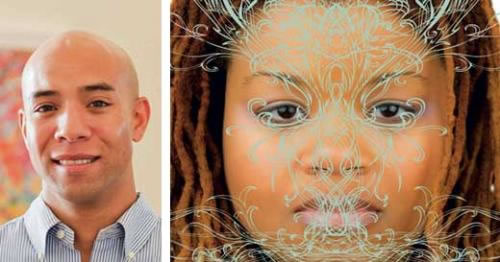
“I am of a mixed-race background, and to the common, suburban, upper-middle class white kid, I looked different,” Hudson says. “Was I black? They didn’t know … it’s been like that my entire life.” “Presentation” features art from three series, including the “Beauties” series where he explores an interest in images of the individual. He used the people featured in Jet magazine’s “Beauties of the Week” category and digitally imposed his face on the bodies.
His exploration into his own racial heritage inspired the works for the “Kentucky Gentleman” series. Working with a makeup artist at Actors Theatre, Hudson masterfully dissected his own identity through disguise. His transformation into nine different races fed commonly understood stereotypes while posing questions about perceptions of self and others.
“I wanted to be black, and I wanted to be white,” Hudson says. “I wanted to be Chinese, Japanese … whatever. I wanted to be Native American. I wanted to be a funny person of Latino dissent I called ‘Miami Bryce.’ I wanted to be that Mexican painter that would come in and do that painting job. I wanted to be Jewish.”
In his “Holding Pattern” series, he uses headshots of women in their mid 20s and 30s and superimposes decorative patterns on their faces, exposing the ideas of symmetry and femininity. Each pattern enhances the face in its own unique way, bringing the beauty of the women out in new ways.
Whereas other artists might manipulate such subject matter for shock value, Hudson doesn’t look for any specific reaction. An appreciation for diverse audience reactions fuels his fire.
“There’s not necessarily an emotion I’m seeking to evoke,” he says. “I just want someone to think about it. I don’t want it to just be a pretty picture.”
Hudson’s drive to create more than just a pretty picture led to the development of this exhibit. The “Equilibrium (Deco)” series began as paintings with no pattern on top. He retooled these paintings into screenprints and digital prints and placed the pattern on top in order to create an image with repetition and simplicity. With the “Holding Pattern” series, Hudson worked with people as subjects for the first time. His close relationships with women and his many travels helped him find inspiration.
Hudson’s philosophy is simple: Experimentation and evolution are essential to artistic development. As he continues to push himself in new directions, he stays true to this mantra.
“I’m really uncomfortable when I see an artist or meet an artist that picks up one thing and just sticks to it,” Hudson says. “Someone’s work that doesn’t change and isn’t fed by outside influences — that’s worked for a whole lot of people, but things start to look the same. You don’t want to become bored in life. It’s my philosophy — it’s what I appreciate in others, and it’s what works for me.”
It’s easy to assume Hudson would want to take some time to digest his newest show and the works he created, but he doesn’t seem to operate with a stop button. His next task is working with glass and ceramic pieces. Though he’s seen it done before, he’s never experimented with the techniques and is eager to try something new. It is important for him to continue to challenge the boundaries of art and test his limitations as an artist in a world that is constantly evolving.
While some people express themselves through words, Bryce Hudson does so through molding pieces that make viewers think. He doesn’t create art to please, but to present a thought, a feeling, a message.
“This is what I am presenting, and people can choose to look at them,” he says. “I really hope people choose to dive in a little bit further … you can always glance at something and take it at face value, but what I always hope is that people will get into it. It’s the same with music — you may really like a song and you can take it as ‘that’s my song,’ or you can take it because it connects with you on some level. So, I mean, it’s the viewer, it’s really their decision how much they want to take from it. They can take all they want.”
A Stroke of Genius
Written by: Angie Fenton
The 31-year-old artist’s work hangs in private and public collections around the world, including the “Kentucky Gentleman” series, which was purchased by Brown-Forman. The print collection is a fascinating exploration of Hudson’s personal struggles as a multiracial being. With the expert assistance of makeup and wardrobe professionals from Actors Theatre, he transformed his ethnicity over and over again – morphing from white to black, Hispanic to Asian – without the use of prosthetics.
Positively Kentuckiana: Iraqi artist living in Louisville blends cultures on canvas
Louisville, Ky. (WHAS11) - Hers has been a life of two worlds coming together on canvas; her life in Louisville and her life in Iraq. This artist has seen war and murder, so how is her story part of our Positively Kentuckiana? As WHAS11's Rachel Platt found out, it's all about hope. Every picture tells a story and there are so many stories being told by artist Vian Sora. She is an Iraqi artist who now calls Louisville home. Her life then and her life now come together on canvas. One painting called ‘Between Two Worlds’ is the featured piece in an upcoming exhibition. It is something of a self portrait; her inner and outer world with roots in both places, a blending of east and west. She married a Louisville attorney who worked with Iraqi artists. It is a marriage that would once again blend two worlds. “I don't want to leave my identity…I talk English here but Arabic to my family,” she says. It is a family that's endured torture and murder. She showed WHAS11’s Rachel Platt articles and pictures of her uncle, the Deputy Health Minister who was kidnapped in 2006 and later murdered for exposing wrongdoing. The work simply entitled ‘Kidnapped’ was inspired by him. “Man with dagger represents the 16 men who attacked,” says Sora. The painting pays homage to a man she loved and respected; a dark time and a dark painting. But despite the ravages of war, her paintings also reflect beauty both in Iraq and Louisville. Later this month you'll be able to see this artwork for yourself. Vian's paintings have been shown throughout the world but this will be the first time in Kentuckiana. It’s a new life in a new place with her artwork providing a bridge to her past. “When you survive every day, life becomes more meaningful and beautiful and you enjoy the small things,” she says. Vian Sora an artist who has seen the dark but prefers to paint hope. “This is my way to contribute to beauty and color,” she says. If you would like to see ‘Between Two Worlds,’ her work will be on display from April 2nd until May 14th. The exhibit is at the Green Building at 731 east Market Street. If you have someone who fits the bill for Positively Kentuckiana we want to hear from you. Bristles with Energy
Steve KeeneVelocity WeeklyMay 19, 2009
Steve Keene says his art is like a CD — and this has nothing to do with his designing cover art for some of the world's hippest indie rock bands. It's disposable and forgettable or pleasing and memorable, depending on who owns the wall where the piece hangs.
Keene, a Brooklynite, creates scores — and sometimes hundreds — of pieces at single settings, swiftly stroking vibrant paint onto 16-by-20-inch planks to create whimsical images of houses, the Beatles and American presidents. Keene sells the paintings for no more than $14, plus shipping — roughly the price of a CD — through stevekeene.com. Last month, Keene visited Louisville for 10 days to paint — as much performance as it is production — and show his work at the Green Building on East Market Street downtown. He's departed now to his Brooklyn studio, but the exhibition remains open until May 29. We caught up to chat about his time here.
How did your time in Louisville go? I sent down about 1,200 paintings and I painted about 600 more when I was there last month. It's a performance, what I do. It's sort of like a stress test for me, because when you do art it's supposed to be really special and you're supposed to work on it really hard and you're not supposed to have that many interruptions and it's supposed to be really good. And when I do it, it's like I'm out on the street, practically. I paint in front of people; people come check out what I do. It's kind of a test to see if I can survive. The best part of it was they were opening up this restaurant (732 Social) in the front of the Green Building. I've always worked in restaurants, and I think of myself as making something for people to eat, for people to consume. It was fun to watch the restaurant workers breaking their backs doing the restaurant work, and I'm breaking my back doing my paintings. So I felt a complete kinship in the process of putting on a performance and making a product that few hundred people come and buy and they can buy.
Can you elaborate on your views about your art being like CDs? That's about it. I don't really have any fancy ideas about it. I just think it's a thing that keeps people entertained for a few minutes. My paintings are cheap enough that if you don't like it, you can just stick it outside your apartment and let somebody else pick it up. It's cheap. It's entertainment. If you don't like it, you can get rid of it.
How did your art become entangled with indie rock? You've designed album covers for The Apples in Stereo, Silver Jews? Pavement.
Right... It's their love of me. (Laughs.) People see that what I do is unusual. To me it's just a wacked-out job that I invented for myself. When it's at its best, I think it's refreshing and inspiring to see somebody work so hard at something. I take it very seriously, what I do, but I treat it as if it's a game.
Tell me about your painting process. I'll do 50 or 100. It just depends. I might do 20 different ones, 20 apiece. Or I might do 100 of the same thing. It doesn't really matter. I don't really see them as paintings; I see them like doing Sudoku or whatever that number game is called.
You must struggle to think of ideas for paintings, doing so many different concepts each day. I try not to think of it in terms of getting ideas. I'll just pick up on something, and I'll do it. The fewer ideas I have, the better it is, the more satisfying the whole process is. When you have too many ideas, it just throws up too many roadblocks to the process. It's really just about the process. It's about the activity of doing so much.
Many of your paintings feature musicians — there are several Beatles pieces, plus Daniel Johnston, Devo. Music is accessible for people. It's a stepping-stone. I enjoy music, but I also enjoy things that most people who buy my art wouldn't care about. I've been doing this almost 20 years, so I'm aware of what people enjoy. I'm a popular artist, so I don't want to just do stuff that's all about my ideas and what's inside of me. I want it to be accessible to everybody. To me, it's not about whether it's a painting of the Beatles or something nobody else knows about, I want to make something that's supposed to go as quickly as possible into the world and then take on a part of somebody else's life.
How do you think art snobs look at your work? I don't really have anything to say about that. It's like food. There are 4,000 different kinds of restaurants on the East Coast, and that's the way you have to think about it. It's nourishing to some smart people and it's repulsive to some smart people, it's fantastic to some dumb people and it's horrible to some dumb people.
|


 Growing up, Bryce Hudson’s identity was questioned on a regular basis. The summer sun would flush his hair of any darkness while his skin took a golden brown tone. Even now in his adult life, he finds people attempt to place him in categories where he doesn’t belong.
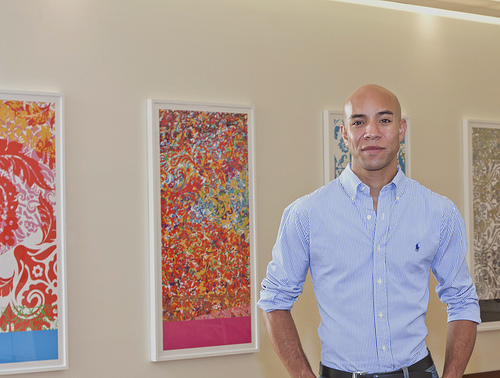 If you Google “contemporary art” and “Louisville,” in .20 seconds, you’ll see a list of 163,000 search results – with Bryce Hudson at the top of the lineup.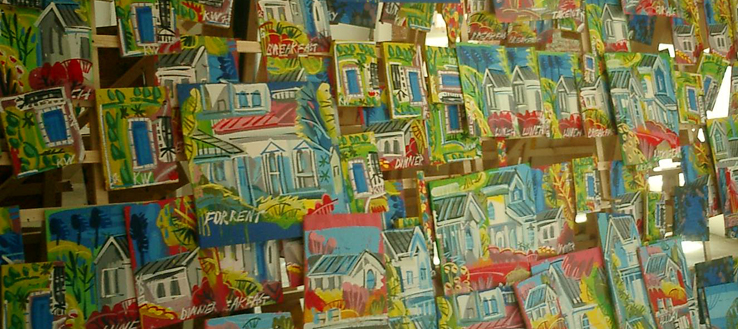



Designed and maintained by contemporary websites